
What is Craniosacral Therapy?
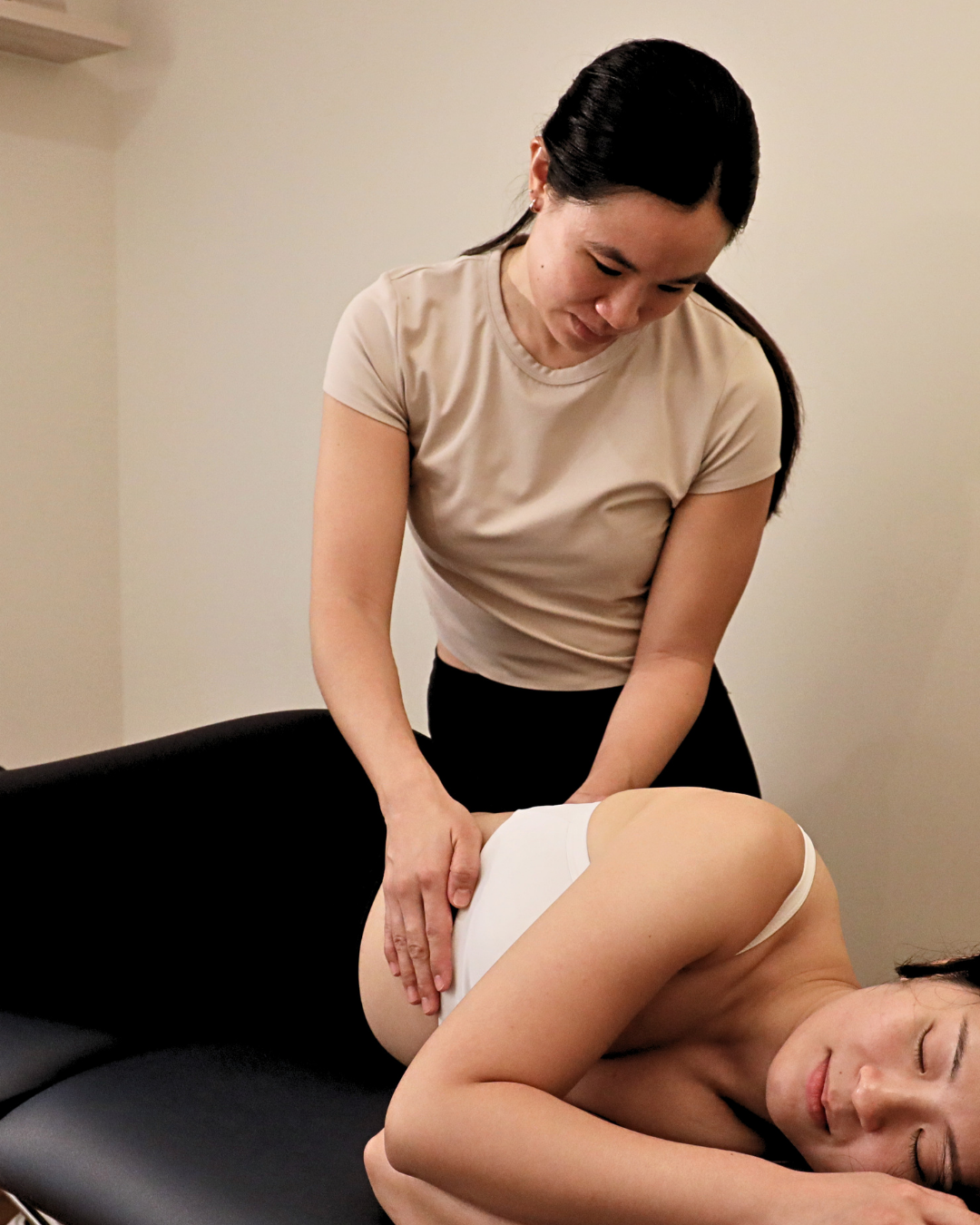
Craniosacral therapy is a gentle, hands-on form of bodywork or manual therapy. You stay fully clothed, lying on a treatment table, while a practitioner makes light contact — often no more than the weight of a hand — at points around the whole body, but typically at the head, spine, ribs, hips and feet. It grew out of osteopathy: the underlying observations were made by the American osteopath William Garner Sutherland from around 1900s, and the name "craniosacral therapy" was given to it by Dr John Upledger in the 1970s.
What it is not is massage. There is no oil, no pressure, no direct manipulation. In fact, most of the work is quiet and the sensations are subtle.
At Soma Haus, craniosacral therapy sits alongside psychotherapy, physiotherapy and somatic bodywork, so it can be part of a wider plan rather than a standalone treatment. First sessions run 75 minutes and follow-ups 50 minutes, at our Joo Chiat and Tanjong Pagar clinics. Sliding-scale rates are available.
What Actually Happens In a Session
A lot of clients come into Craniosacral Therapy not knowing what to expect.
The first session together is typically 75 minutes long as we start with a brief case-history taking, getting to know you, what brought you in, how your body has been doing and what you are hoping for. Afterwards, you lie down on the treatment table, fully clothed and usually on your back. Your practitioner may offer a bolster under your knees or a blanket.
From there, the practitioner will make light contact with your body and “listen” to different “stations” or parts of the body. Sometimes the practitioner may stay in an area longer than others. What practitioners are feeling for is where your tissue is holding, where it wants to move, or where it wants to let go or unwind.
You can talk during a session or stay quiet — both are fine. Some practitioners engage with more talk to help you ease into the bodywork or treatment because for some bodies, learning how to rest or even relaxing isn’t always an easy go-to.
As you can imagine, silence plus touch plus closed eyes can be a lot. Being touched by someone you can't see, with nothing external to anchor to, is its own kind of vulnerable — particularly if your history is relational. In that situation, having the practitioner use verbal affirmations and cues can act as a strong cue for safety. The conversation lets you orient outward to the room and back again rather than staying submerged in sensation. Moving between the two is often more settling than going deep and staying there.
Some therapists also use talking as a tool to track sensation; asking what's happening in your chest, or where you notice the breath now, keeps you in contact with your own experience rather than drifting off. Drifting can look like deep relaxation from the outside, and sometimes it is, but in some cases, it could be indicative of your system leaving the room (in the case of dissociation).
For those who may be more used to light touch or bodywork like Craniosacral therapy, the silence can feel like a warm hug. Silence can be a powerful tool too because sometimes talking too much can keep you from the neck up, narrating your body instead of feeling it. So finding that balance is part of the work, this is how we stay attuned to your body and its needs in the here and now.

What Craniosacral Therapy Feels Like, Including The Part Nobody Mentions
Most people describe deep rest. Heaviness, lightness, warmth, a sense of sinking or floating. Some notice pulsing, subtle movement, temperature changes, or a sudden yawn or gut gurgle as the system drops out of alert and shifts towards a parasympathetic state. Some clients fall asleep, or drift into a window of relaxed alertness where the body's repair processes are more available.
Some clients cry without quite knowing why, which is common and completely welcome. Emotion doesn't require a story — the bodily part of feeling and the autobiographical explanation for it run on different systems, and you can have the first without the second. It only feels strange because we're taught that tears need a reason to be legitimate.
Depending on your system and what you've come in for, a proportion of people feel worse for a day or two afterwards — tired, achy, emotionally tender, or oddly flattened. It's a well-known pattern, it usually settles within 48 hours, and the actual change tends to follow it. If it happens to you it isn't a sign that something went wrong, and we'd rather you knew in advance than be alarmed by it. If it lasts longer than a couple of days, tell us and we'll adjust the pace.
What we tell first-time clients is to imagine a factory that's been running short-staffed for years. A couple of departments went down long ago and were never properly fixed, so everyone quietly took on someone else's job alongside their own. That's also how the body's adaptive capacity narrows over time, and how symptoms start to appear.
The first session is the first time in years the whole workforce has been in one room together. That alone is tiring; they've been holding a great deal and not talking about it. And in the days afterwards the jobs start getting redistributed. For a day or two the factory runs worse than it did before, because the old workarounds have been dropped and the new arrangement hasn't bedded in.
There's a more literal version of the same thing: chronic arousal masks fatigue. When your system finally comes down out of it, you don't become tired; you notice the tiredness that adrenaline had been covering for months.
We'd also rather say plainly: some people feel very little in a first session and we usually suggest 5-8 sessions with enough consistency to kickstart new rhythms and neural pathways for the body. Craniosacral therapy is learning a different language of the body or self so it does take more than one exposure for change to happen.
What Clients Come To Us For
We see craniosacral therapy help most consistently with:
Chronic pain and long-standing muscular tension
Tension headaches and migraines
Jaw tension and TMJ-related discomfort
Sleep difficulty and difficulty switching off
Burnout, exhaustion, and feeling wired but depleted
Nervous system dysregulation
Immune system support
Digestive issues and tension in the viscera
Anxiety and the physical residue of stress
Support alongside cancer treatment and chronic illness
Periods of grief, overwhelm, or emotional processing where talking has stopped helping
Many of the people we see have complex symptoms that haven't fitted neatly into a diagnosis, and have been told there's nothing wrong. The absence of a diagnosis is not the absence of suffering, and you don't need one to work with us.
When Craniosacral Therapy Isn't Appropriate
Please tell us before booking if any of these apply, so we can talk it through or refer you on:
Recent concussion or traumatic brain injury
Cerebral swelling, brain aneurysm, or known blood clots
Structural abnormalities of the cerebellum
Any condition affecting the stability of cerebral fluid pressure or flow
Acute infection or fever
This isn't a hard no in every case — it depends on your own history. Our practitioners will always have the conversation with you first and adapt the session accordingly.
How To Choose a Craniosacral Therapy Practitioner
Craniosacral therapy has a low barrier to entry and is under-regulated in most countries. An introductory certificate can be earned in a four-day course, and there is no licensing body in Singapore governing who may practise it. Many practitioners offer it as an adjunct or complementary technique alongside something else. The range of skill you'll meet is enormous, and almost none of it is visible from a website.
A practitioner needs a solid grounding in anatomy, physiology and biomechanics to work safely and competently, and the hands-on skills take real time to develop. That's palpatory literacy, and breadth of caseload matters as much as years in practice — you only learn to recognise restriction by having felt a great deal of normal. It's one of the main reasons we prioritise continuous research and education here, rather than treating certification as a finish line.
Touch is also bidirectional. You can't put a hand on someone without being felt in return, so a therapist needs to be doing their own work to stay regulated and grounded.
So if you're choosing a practitioner, here or anywhere else, these are worth asking:
How many hours of supervised hands-on training, and with whom? Named certifying schools — the Upledger Institute, Body Intelligence, Body College, among others — tell you considerably more than "certified" does.
What else do they work with? Look for a bodyworker first, with grounding in structural and myofascial work. They've felt a far wider range of tissue and can tell genuine restriction from ordinary variation.
How do they handle consent? Not only asking at the start, but noticing mid-session when your body braces and adjusting before you've had to say anything. Consent is an ongoing, practical conversation rather than a form you signed.
What do they say they can't treat? The hallmark of a good practitioner is someone who can name their limits, their contraindications and their referral threshold. That's central to ethical practice.
Booking Craniosacral Therapy in Singapore
If you've read this far and something in it landed, that's usually a good enough reason to try a session. If you’re still unsure, we created a simple quiz to help you navigate different services and treatments at Soma Haus. We look forward to meeting you wherever you are at in your health journey.
FAQs
-
Craniosacral therapy is a gentle, fully-clothed form of bodywork using very light touch at the head, spine and pelvis to support nervous system regulation. It developed out of osteopathy in the 1970s and is used for chronic pain, headaches, stress and burnout.
-
The evidence is mixed and worth understanding honestly. The traditional explanations — that it moves skull bones or normalises cerebrospinal fluid flow — are not well supported, and a 2024 systematic review found the strongest supporting trials were seriously flawed.
What is better supported is that slow, sustained, low-threat touch shifts autonomic state and supports relaxation. Many clients find it valuable on those terms.
It's also a felt-sense practice, and that matters for how you decide. Trials describe what happened on average across a group, not what happens in your body — and the outcomes here (rest, ease, feeling less braced) have no biomarker. Gentle touch is also hard to study well, because there's no obvious sham for a hand resting on someone. So weak trial evidence is partly a methods problem rather than only a verdict.
None of which means taking it on faith. Try it if you're curious, then judge it by what actually changes in the
-
The traditional explanation — that it moves skull bones or alters cerebrospinal fluid flow — is poorly supported. A better-evidenced account is that slow, light, sustained touch engages C-tactile nerve fibres in the skin, which project to brain regions handling emotional and bodily state rather than touch location, and that fascia is densely innervated sensory tissue whose tone is partly set by the autonomic nervous system. On that account, craniosacral therapy works by shifting nervous system state rather than by mechanical change.
-
No. There's no oil, no pressure and no muscle manipulation. You stay fully clothed and the contact is very light unlike a massage.
-
Yes, and it's common. The touch is deliberately light enough that your nervous system stops tracking it, and the changes it supports are mostly absences — bracing that quietly stops — which are hard to feel as they happen.
If you've held tension for years, its easing registers as ordinary rather than as relief. That said, sometimes not much does happen.
Rather than take it on faith, watch your sleep, pain, breath and reactivity over the following week.
If nothing shifts across three sessions, tell us and we'll change approach or refer you elsewhere.
-
It's common. Holding feeling back is physical work involving the jaw, throat, diaphragm and chest, so when those areas soften the holding softens too.
Tears are also part of the parasympathetic shift into rest, alongside yawning and gut sounds. And crying is physiologically incompatible with defending yourself, so it tends to arrive when your system has decided the room is safe. Not knowing why is normal — the bodily part of an emotion and the story that explains it run on separate systems. Crying in a session is not evidence that a specific memory has surfaced, and a practitioner shouldn't interpret it for you.
-
It varies, and it should. Some people settle better with a steady voice and light conversation — the human voice is a strong safety cue, and orienting outward to the room and back is often more regulating than staying submerged in sensation.
Talking also lets the practitioner track where your attention is, rather than letting you drift off.
For others, talking keeps them thinking instead of feeling, and silence is what allows the body to lead.
A good practitioner reads which one is helping in the moment and changes as needed. Tell us either way.
-
Some people feel tired, achy or emotionally tender for a day or two afterwards. It's a recognised pattern and usually settles within 48 hours, with the actual improvement following it. One way to think about it: a factory that's been running short-staffed for years, where everyone has quietly absorbed someone else's job, doesn't get better the moment the whole workforce finally meets — it runs worse for a couple of days while the jobs are redistributed. A more literal account is that chronic arousal masks fatigue, so coming down out of it means noticing tiredness that was already there. Rest, drink water, and let your practitioner know so the next session can be paced differently.
-
It varies. Recent, specific complaints often shift within one to three sessions.
Long-standing chronic pain or trauma usually needs a longer arc.
We review with you after 3 sessions and will tell you if it isn't working. We usually recommend between 5-8 sessions as part of an intervention.
-
They're the two main branches. The Upledger stream is biomechanical: the practitioner assesses restrictions in tissue and membrane and engages them directly with applied technique, working from the outside in.
Biodynamic craniosacral therapy (BCST) is quieter: the practitioner settles into neutral, holds a wide field of attention and follows the body's own reorganisation rather than initiating change, working from the inside out. Biomechanical work often suits specific structural complaints; biodynamic work often suits highly sensitised systems.
Both are available at Soma Haus and most experienced practitioners move between them.
-
Biodynamic craniosacral therapy is the quieter branch of craniosacral work, developed from William Sutherland's later teaching and carried forward by Rollin Becker, James Jealous and Franklyn Sills.
Rather than treating restrictions directly, the practitioner works from stillness and follows the body's own reorganisation. Sessions involve long, still holds and very little applied technique.
Practitioners often hold the RCST (registered craniosacral therapist) designation that involves ongoing supervision, study and practice.
-
It's generally not covered by health insurance here, though some employers include it under wellness benefits.
Where craniosacral techniques are used within a physiotherapy session delivered by a registered physiotherapist, that session may be claimable as physiotherapy; check with your provider.
