
Our First Handpan Training for Yoga & Meditation in Singapore
Here's something most of us know in our bodies long before we know it in our heads: music can move us in such a powerful way. A song can lift you into joy, or drop you straight into a grief you thought you'd finished with, or settle you into a quiet you couldn't find any other way.
These emotional responses are not just subjective experiences; they originate in complex neurological processes in our brains. Different parts of the brain respond to specific musical elements, such as rhythm, melody and harmony. Listening can shift the chemistry that shapes our mood, our emotions, our sense of closeness to other people: dopamine, serotonin, oxytocin. It's part of why music therapy or sound therapy has built a real evidence base in mental health care. Recent systematic reviews and meta-analyses find meaningful reductions in anxiety and in depressive symptoms, with the research on trauma and PTSD younger but moving in a promising direction.
This weekend, we hosted our first Handpan Training for Yoga & Meditation at our Joo Chiat Clinic and studio with Edoardo Striani, artist and handpan teacher based in Bali. He has been playing since 2012 and teaching since 2017, with hundreds of workshops and performances across Europe and Asia. We chose an intimate format with only 5 participants (max capacity). Partly that's practical: this isn't an instrument you learn by watching, so everyone needed their own handpan under their own hands, and enough of Edoardo's attention so that nobody spent the training feeling left behind or out of sync.
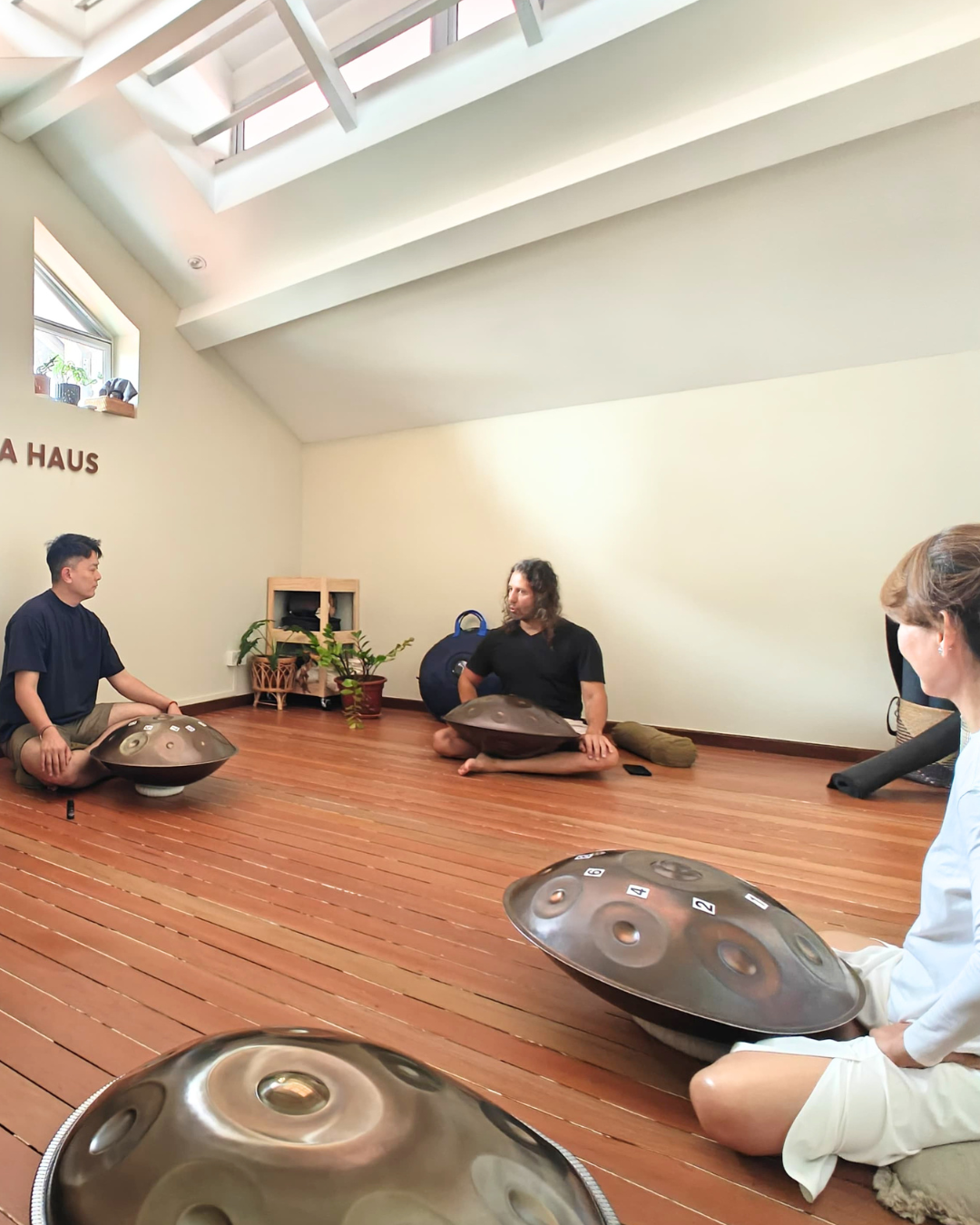
What Is a Handpan — and Why Is It Such a Powerful Instrument?
If you haven't met one: a handpan is a steel instrument, shaped a little like two woks joined at the rim, played with the hands rather than sticks. The family is young — the first of its kind was made in Switzerland in 2000 — which is part of why so many people have heard one without knowing what they were hearing.
What sets the handpan apart is its warmth. When the metal resonates, it doesn't produce a sharp or demanding sound; instead, it belongs to the same family as singing bowls and gongs, with long sustain, rich overtones, and a slow decay that creates a soothing listening experience.
The most beautiful and most forgiving aspect about a handpan is that it is tuned to a single scale, meaning every note on the instrument is harmonically compatible with every other note; you physically cannot play a wrong one. What we saw, especially this weekend, is that a beginner to sound or handpan can learn to play something so genuinely beautiful, calming and meditative. The handpan seems to bypass the analytical mind and speak directly to something deeper, and is what most participants walked away feeling.
“It was so good! Edoardo is a really good teacher. And I think it was well curated for the purpose of the workshop. I learnt a lot! ”
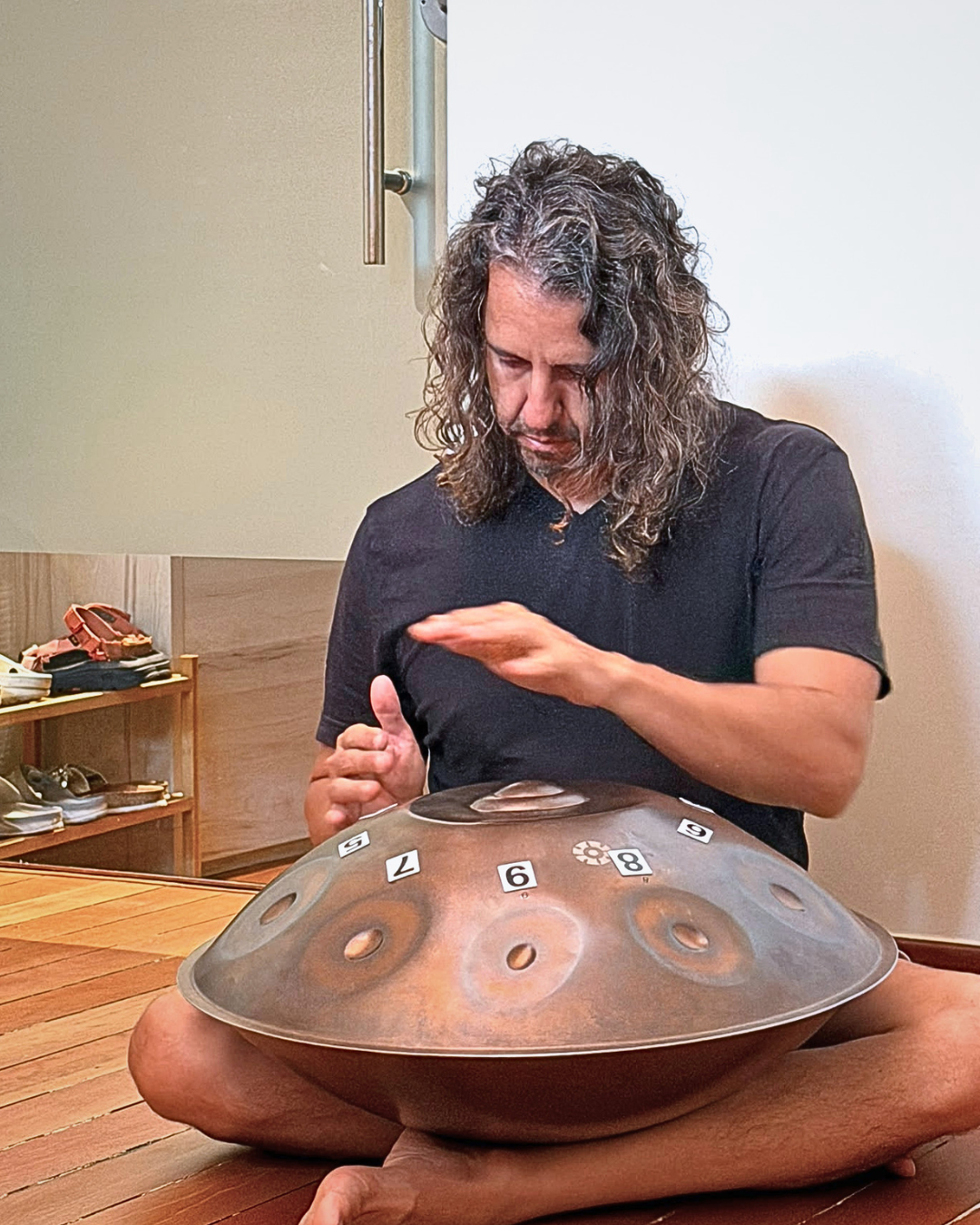
“He is incredibly encouraging, funny, and passionate, which made the class both enjoyable and engaging. The other participants were also a great group to learn and practise with.
Overall, it was a fantastic experience for me, especially because of the techniques he taught and the way he guided us through them. The class has also really increased my confidence in playing the handpan, which I truly appreciate.”
Sound, Safety And The Nervous System
The most useful way we've found to describe it: sound gives the nervous system something slow, predictable and non-threatening to orient towards. Orienting is a small, constant, mostly unconscious activity in which the system scans the environment and asks, in effect, is it safe here? Stephen Porges calls this process neuroception, and his polyvagal framework has been enormously influential in trauma work. The point is that this appraisal happens below conscious thought — you don't decide to feel unsafe, and you can't reason your way out of it from the neck up.
Which is exactly why sound is such a useful doorway. A sustained, low-threat, repeating tone is easy for the system to orient to and keep orienting to. Nothing about it demands vigilance. This is also why, in a matter of a few minutes, many people find their breath lengthens on its own, and their attention softens. It didn’t happen because they were instructed to relax (of course, having Edoardo Striani as a teacher helps heaps) but because there was nothing left to brace against. This is the same principle underneath everything we teach in our 30hr- sound therapy training.
Another beautiful thing about the handpan is that it is bilateral by nature — two hands, alternating and independent, striking, damping, sometimes doing entirely different things at once. It's low-impact, seated, and adaptable to a wide range of bodies. Using a handpan helps anyone who enjoys or even struggles with sitting meditation because it asks you to notice your attention wandering and bring it back. The handpan's sound is melodic enough to downregulate the nervous system. Similar to how we teach singing bowls, participants may not end up using the instrument to teach or guide meditation, but instead use it as a personal resource to self-soothe.

A few things people asked us
-
Unlike a typical introductory workshop, which focuses on offering a first experience with the instrument, this training follows a structured curriculum over 6 hours.
Participants progressively develop technique, coordination, musical patterns, and practical playing skills through guided practice and repetition. The goal is not simply to experience the handpan, but to build the confidence and foundations needed to continue playing independently.
-
While the literature is not on the handpan itself, we can see how sound can be a powerful way of working with the mind, body or our nervous system.
There is a growing body of clinical research on sound-based interventions, most of it on singing bowls. A 2025 systematic review in Integrative Medicine Research gathered nineteen clinical studies from eight countries and concluded that singing bowl therapy may have potential to reduce anxiety and depressive symptoms and improve sleep quality. An earlier observational study by Goldsby and colleagues, with 62 participants, found significant reductions in tension, anger, fatigue and depressed mood following a single sound meditation session.
-
No. The training is specifically designed for complete beginners.
However, if you have never touched a handpan before, we recommend booking a lesson or course with Harmonic Circle beforehand.
Attending it is optional but will help you tremendously during this programme.
-
By the end of the training, you will have developed a foundation in handpan playing, essential techniques and a repertoire of simple rhythmic and meditative patterns. If you are a yoga teacher or meditation practitioner, you will also be able to accompany savasana, relaxation, and personal contemplative practices with live handpan music.
-
No. Instruments are provided for the training. If you decide afterwards that you want one, we can point you towards makers and scales that suit what you're drawn to — it's a considered purchase and worth not rushing.
-
No. While the training emphasises applications in yoga and meditation, it is open to anyone interested in learning the handpan and can easily be integrated into your own personal practice.
-
It's adjacent to one. If you want to learn to lead a full sound session with bowls, gongs, and the theory behind them, our sound therapy training is a better fit. The handpan training is about the instrument, the scale, and how to weave it into a yoga class, a meditation, or your own practice.
If you missed us this weekend in August and you would like to be reminded of future trainings or workshops like this, sign up via our handpan training page and will update you as soon as we release new dates.
Soma Haus is a multidisciplinary somatic wellness clinic with two locations in Singapore — Joo Chiat and Tanjong Pagar. We work with people navigating chronic pain, burnout, anxiety and complex health conditions, using approaches that begin with the body.
